Find the objective before treating the route as familiar
The original Deko has eight levels with enemies, spikes and saws along the way. Collect the ice cream and work toward the pink flag. A recognisable platform format makes the basic goal easy to describe, but the current layout still needs to be inspected.
Use WASD or the arrow keys for movement, with W or Up for jumping and the double jump. Begin by seeing how the character responds on a readable section. Decide where you want to land before relying on an additional input near a hazard.
Follow a collectible with a landing plan
An ice cream gives you a destination, but reaching it may leave another movement decision immediately afterwards. Read the surface beyond the collectible and notice any hazard that affects the exit. The useful route includes both the approach and the continuation.
If an enemy moves through the area you want to cross, observe its current position. Do not assume that recognising a familiar enemy shape tells you the timing of this particular encounter. Waiting to understand the available space can be more informative than committing to an uncertain jump repeatedly.
Compare the sequel without copying a whole sequence
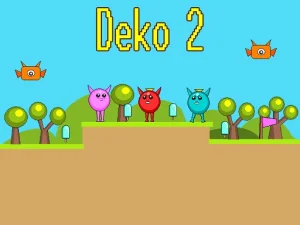
Deko 2 continues the same central collection-and-flag objective through another eight-level set. It documents WASD or arrow movement and pressing W or Up twice for the double jump. Familiarity with the original helps you recognise the actions, while the sequel's actual platforms determine where to use them.
Carry over a habit rather than a memorised route. Choosing a destination, watching a moving obstacle and leaving room for the next jump remain useful practices. An exact sequence from another layout has less value when a saw, enemy or platform occupies a different position.
Use failure to separate movement and timing
A missed landing can have more than one cause. You may have chosen an unsuitable destination, left the ground from an awkward position or used the additional jump at an unhelpful moment. Identify the first decision you can understand before changing the next attempt.
Keep the successful part of a crossing as a reference. Adjust one uncertain choice and watch its effect. This gives repeated attempts a purpose beyond pressing the keys faster, particularly as the levels become more demanding. The verified descriptions establish increasing difficulty, not a universal speed requirement for every section.
Browse beyond one interpretation of retro
The Retro collection includes separate titles with their own presentations and rules. Its label does not establish a shared release date, an original console version, identical music or a common save system. Read the selected destination's description if those details affect what you want to play.
Deko is a clear choice for practising its first set of platform layouts; Deko 2 offers another set once you understand the same core objective. You can also use either as a focused movement exercise rather than trying to finish everything in one sitting.
Before leaving, inspect any progress or continuation information the loaded interface provides. Keep a concrete lesson from the session, such as a better landing choice or a clearer second-jump response. That observation will help you approach another platform game without pretending that all games under the Retro label are mechanically identical.