


Cluster Truck Searches: A Guide to US Army Truck Driving
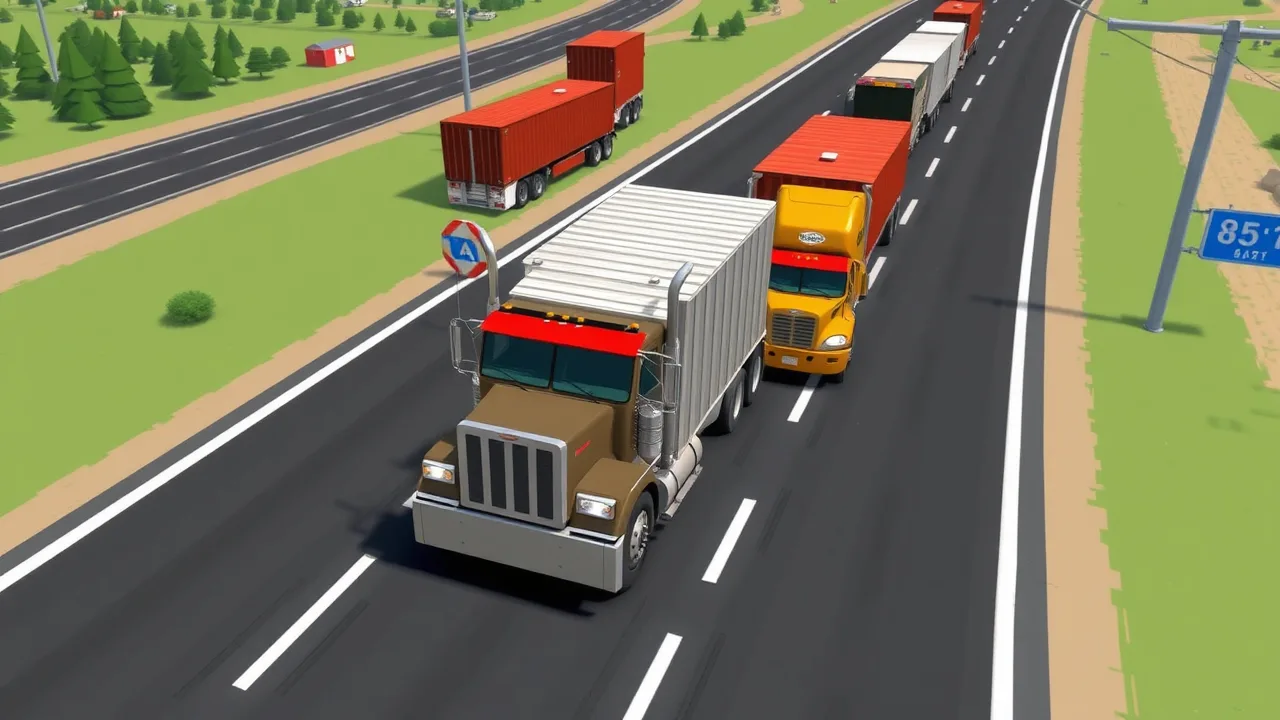
Searching for Cluster Truck can lead to several different kinds of truck game. Jumping between moving vehicles, racing a truck and delivering cargo are different activities, even when their titles share the word “truck.” The current collection on this site contains many driving and transport choices. This guide focuses on US Army Truck Driving, a specific cargo delivery game, so you know what to expect before opening it.
In US Army Truck Driving, you take a military truck through demanding routes to transport supplies. The supplier describes highways, mountain terrain, muddy roads and rough off-road sections. The documented driving controls are WASD or the arrow keys. Your immediate task is to read the current mission, follow its route and deliver the cargo carefully. This is vehicle driving, rather than a promise of the original truck-jumping platformer.
Read the mission before leaving the starting area
Before accelerating, identify what the current screen asks you to do. Look for the destination, route guidance and any condition the mission explicitly displays. Do not assume that an objective from a previous level applies unchanged. A transport game becomes easier to understand when you know what counts as a successful arrival before deciding how aggressively to drive.
Use the beginning of a mission to inspect the truck's position relative to the road. If you start at an angle, straighten gradually instead of combining a large steering input with immediate acceleration. A controlled departure gives you time to understand the vehicle's response. It also reduces the chance of creating a problem before you have read the first part of the route.
Avoid inventing requirements that the interface has not shown. The supplier confirms cargo missions and increasingly demanding challenges, but that does not establish a universal fuel limit, damage meter or special parking sequence for every level. Follow the actual objective and indicators in the loaded mission. Advice is useful only when it fits the rules that are present.
Establish a measured steering rhythm
WASD or arrow keys provide the documented driving input. Click inside the game so those keys reach the truck rather than the surrounding browser page. Begin with a modest movement and observe how readily the vehicle turns. Large trucks can be visually harder to place in a narrow view, so use the available road space carefully while learning the simulation's response.
Make the next input based on where the truck is now, not where you expected it to be. If it is drifting toward an edge, release an excessive turn and correct gently. Holding the opposite direction for too long can produce a second problem on the other side. A slower pace gives you more time to judge how much correction is enough.
Keep the control layout consistent while you learn. Alternating between arrow keys and another input arrangement during the same difficult section may add confusion without solving the route. Once you have a reliable basic rhythm, you can explore other options that the game's own interface offers. Do not borrow undocumented shortcuts from a different truck simulator.
Choose speed for the available space
Cargo delivery rewards reaching the destination, so think about how much room the next manoeuvre requires. A broad, readable stretch may support a different pace from a narrow mountain bend. Look ahead and reduce speed before the space becomes restricted. Waiting until the truck is already at the edge leaves fewer useful choices.
When you are unsure how a corner unfolds, enter it at a pace that allows observation. You can increase speed later if the road opens up and the mission permits it. Committing early to a fast approach can make a simple turn feel like a sudden emergency, even when the real issue was the time you allowed yourself to read it.
This is guidance for playing the simulation, not instruction for operating a real military truck. Game physics, camera views and mission rules simplify many things. The useful in-game habit is to connect your speed with the information and space available on screen, rather than treating every route as a race regardless of its objective.
Plan mountain bends before committing
The supplier lists mountain environments among the game's routes. In a constrained section, inspect the road line beyond the first visible curve. A bend may lead into another turn or an obstruction, so the most direct entry is not always the easiest position from which to continue. Give yourself room to see what comes next.
Break a difficult route into manageable sections. First bring the truck to a stable line approaching the bend. Then guide it through the turn. Finally, check that it has enough space for the next part before adding more acceleration. Treating those as separate decisions can make the route more understandable than holding several inputs and hoping the vehicle clears everything.
If the truck repeatedly reaches the same awkward position, change the approach rather than only the final correction. The problem may have started earlier than the point where the vehicle left the intended line. Reviewing that earlier decision gives you a more useful adjustment for the next attempt.
Watch rough terrain without guessing its rules
US Army Truck Driving includes muddy roads and rough off-road environments in its supplier description. Those settings are reasons to pay attention to movement and route readability. Watch how the current vehicle responds on the visible surface. Do not assume that every dark patch triggers a particular penalty or that an unmarked section has a hidden damage rule.
Choose a route through the available space that avoids obvious obstructions and leaves room for a correction. Where the surface makes the truck's movement harder to judge, reduce the number of things you are trying to do at once. A gentler input can help you see whether the problem comes from steering, speed or the terrain interaction.
Be cautious about guides that promise one universal technique for every off-road game. Some simulations model traction differently; others mainly use the terrain as a route challenge. The practical evidence is the response of this loaded game and the conditions displayed by its mission. Observe that response before assigning a detailed mechanical explanation to it.
Approach obstacles with a route, not a last-second swerve
The game's description explicitly includes avoiding obstacles while transporting supplies. Identify an obstruction early enough to choose a path around it. Look for the usable road on both the approach and the exit. A manoeuvre that clears the first obstacle but points the truck toward the next one is not yet a complete solution.
Reduce speed if you need more time to assess the available space. Then make a measured directional change and return to a useful line when the obstacle has passed. If the truck's size is difficult to judge from the view, allow more room rather than trying to prove that the narrowest possible gap is passable.
After a failed attempt, name the first decision that made the route difficult. Perhaps you saw the obstacle too late or began the turn from an unsuitable position. Correct that cause during the next attempt. Repeating the final swerve more forcefully may leave the original problem untouched.
Make the destination a separate final task
Reaching the general area of a destination and satisfying a mission's completion condition may not be identical. As you approach, read the current marker or prompt carefully. Slow down enough to understand where the game wants the truck and whether another displayed instruction remains. Let the interface confirm success rather than assuming that driving near a marker has finished the job.
Avoid adding a fictional parking procedure to every delivery. Some missions may use a clearly marked arrival area; others may present their own prompt. The important habit is to read and follow what is actually on screen. A guide should help you interpret the task, not replace it with a sequence invented for another simulator.
When a mission completes, take a moment to see what the game has changed. The supplier describes rewards and increasing challenge, but the current interface determines what those mean in your session. Do not spend or select something automatically just because a generic truck guide tells you that an upgrade is always required next.
Improve one part of a difficult delivery
Choose a small focus for a retry. You might aim to leave the starting area with a straighter line, enter a mountain bend more slowly or identify an obstacle earlier. Keep the rest of the route as consistent as practical. That comparison tells you whether the chosen adjustment made a useful difference.
If a section already works, preserve it while studying the uncertain part. Constantly redesigning the entire run can make a route feel less familiar even after several attempts. A dependable opening gives you more attention for the later decision that needs work. Once the full route makes sense, you can look for a smoother overall delivery.
Success does not have to mean using maximum speed. A clean arrival that you can reproduce deliberately is a meaningful improvement. Notice whether you can explain why the truck reached the destination more reliably. That understanding is more useful for the next mission than an unexplained lucky run.
Select the truck game that matches your intention
The Cluster Truck Unblocked collection currently brings together multiple truck driving titles. Check each card's actual task. Cargo transport, top-down racing and moving-platform jumping do not share one set of controls or strategies. This guide recommends a particular transport game without claiming that it is the same release as a similarly named platformer.
Open it where gaming is allowed, give the embedded game time to load and keep the play area focused when using the keyboard. If the surrounding page loads but the frame does not, distinguish that access issue from a driving mistake. Once a mission is running, start with the objective, read the road ahead and make each delivery decision early enough that the truck has room to respond.