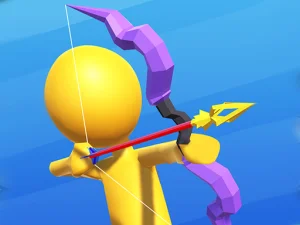
Identify the controls for each archer
Stick Archers Battle uses W for the blue player and Up Arrow for the red player, with on-screen tapping buttons also documented. Follow the bow animation to understand the aiming and release sequence. A short control reference should be read together with the response shown by the loaded game.
Learn which input belongs to your side before a shared-device contest. Two players should be able to distinguish their own action without reaching for the same control. Practise an understandable shot first, then use the result to improve your estimate.
Choose a mode with a clear expectation
The RHM Interactive game offers 1 Player, 2 Player and Death-match options. The verified standard contest is won by the first player to reach five points. Read the selected mode's own instructions rather than extending that description to every possible variation automatically.
In two-player play, the shared screen gives both participants the same visible scene, but each still needs to judge a separate release. Agree on the displayed mode and controls before beginning. The objective is easier to follow when both players understand what the current round is counting.
Read the whole arrow path
Curved shots require attention beyond the initial direction. Watch where an arrow passes relative to the opponent, then notice the final part of its route. A shot that begins toward a target can still pass above or below it before arriving.
Use an observable miss to choose the scale of a correction. If the path was close, a smaller change may teach you more than replacing the estimate completely. You are comparing an adjustment with something you saw, not relying on a universal winning setting.
Reassess when the scene changes
The environment and physics can change the estimate required. Check the distance and relative positions again when the visible situation differs. A successful release from another arrangement is useful experience, but it is not proof that the same input fits the present scene.
Separate learning the control response from reading the new positions. If you understand the action but the setting changed, concentrate on the path. If the action itself remains uncertain, use a clearer attempt to understand the release before drawing conclusions about the environment.
Keep the next attempt informative
Choose one question after an unsuccessful shot. You might want to see whether a more measured release changes the path enough, or whether you misread the target's position. Retain the part of the estimate that was useful while testing the uncertain part.
In a competitive round, the score explains the immediate result, while the arrow path explains something about the decision. Watching both gives a better basis for another attempt than pressing as often as possible without observing where the shots travel.
Use the collection to find the right bow challenge
Other Archer entries have their own aiming systems, objectives and player arrangements. Read the destination's instructions before borrowing W, Up or the five-point standard from Stick Archers Battle. A bow theme does not establish identical trajectories or common progress between games.
Choose this example for its short exchange of curved shots and its documented local two-player option. Check the current player for pause and continuation details before leaving. A useful session goal is understanding one relation between a release and its observed path, then making the next choice with a more reasoned estimate.