Learn the team rhythm in Rim Rebels 3v3
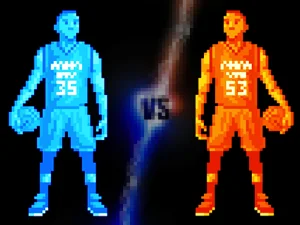
Rim Rebels 3v3 uses teams of three and two baskets. Matches run across four short quarters, each beginning with a jump ball. Every team has one Super Shot for that quarter. CPU difficulty choices and online match or room options give you different ways to start a session.
A CPU match is useful for learning inputs without assuming that another participant is available. Online play depends on the game's current service and the people using it. Select the activity that fits your session first, then read the match information rather than treating every menu option as the same kind of contest.
Separate a shot from a pass
Move with WASD or the arrow keys. Hold J or Space to hang before releasing a shot, and use K for a pass. Holding K produces a pass fake. That difference makes the duration of an input part of the decision, so practise tapping and holding deliberately before relying on them in a crowded possession.
Watch a teammate's position before passing. A useful pass changes where the next decision can happen; it is not simply an alternative animation to shooting. If the nearby space is crowded, consider which player has a clearer route or view of the basket. Repeatedly taking an immediate shot can prevent you from learning the value of those options.
Reconsider the controls when possession changes
On defense, K attempts a steal and J handles a reach-in or block. E switches players, while Shift provides turbo. Shift combined with K near the basket performs an alley-oop. These are the documented actions for this game, not a universal basketball control layout to transfer to every title in the tag.
Practise one change of role at a time. Notice when your team loses possession and what the same action button now does. Choose the player you want to control instead of continuing to chase the ball with an inconvenient position. Understanding that transition makes the match easier to read than treating attack and defense as unrelated bursts of button presses.
Use the quarter structure to shape a session
Four short quarters give a match its rhythm, while the Super Shot allowance belongs to each quarter. Read the game's current display before building a plan around that option. The existence of a special shot does not establish an activation key or a scoring guarantee beyond what the interface explains.
Use Esc or P when you need the documented pause. Give yourself time to learn movement, ordinary passing and release timing before trying every combination at once. A smaller set of understood actions is easier to apply to a possession than a long list of commands you have not yet connected to the visible play.
Review the possession rather than only its ending
After a missed opportunity, think about what happened before the final shot. Was a teammate open? Did a fake create useful space? Did switching players improve the defensive position? A result at the basket is important, but the earlier decision often explains why that result became difficult.
Choose one focus for another match, such as a more deliberate pass or a clearer change from offense to defense. Compare similar situations and notice whether the adjustment helps. Explore the basketball collection for an activity you enjoy, then follow its exact controls and match rules instead of assuming every hoop game is a full team simulation.