Connect a pictured quantity with its written number
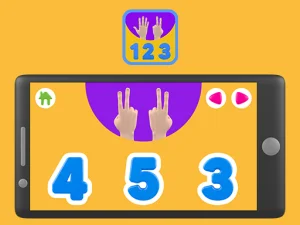
123 game, made by nau.kids, uses pictures of fingers. Look at the hands, count the raised fingers and select the answer that matches. Mouse clicks or touch selections provide the response. The task is to connect a visible quantity, the number you say aloud and the numeral you choose.
A child can reproduce the pictured quantity using their own hands. Count each raised finger once, then compare the result with the available choices. An adult can ask the learner to explain the count before selecting. This makes an incorrect choice something to investigate, rather than a reason to click another number without checking the picture.
Work out a product from two selected factors
Multiplication Roulette uses moving number selectors to create a sequence of ten questions. Click or touch Spin, stop the roulettes to select the factors and calculate their product. The operation is multiplication: read both displayed factors before choosing the answer through the on-screen controls.
Use a known fact when a product is unfamiliar. For six groups of seven, five groups make thirty-five and one more group adds seven, giving forty-two. This connects the calculation with equal groups instead of relying only on the appearance of a memorised answer. After ten turns, revisit one uncertain fact before immediately trying to beat a response time.
Read the operation in a timed arithmetic quiz
Noob Math Challenge presents short addition and subtraction calculations. Select an on-screen answer before its twenty-second countdown reaches zero. A correct answer increases the score and brings another question; a wrong answer ends the round. Running out of time also produces a game-over result, so repeated guessing is a poor substitute for finishing the calculation.
The verified question generator uses single-digit addition. Its subtraction pairs a number from five to nine with a smaller number from one to four. Look at the plus or minus sign before starting the mental calculation. Addition and subtraction can use familiar digits while asking for entirely different results.
Choose a strategy that fits the operation
For a small addition, start with the larger number and count upward by the smaller amount. For eight plus three, count on to nine, ten and eleven. For subtraction, count back and check that the result is smaller than the starting number. These checks help catch a mistaken operation before you choose an answer.
For multiplication, describe equal groups or use a nearby product you know. Counting fingers in 123 game serves a different purpose again: the picture is the evidence for the quantity. Moving between these activities can be useful, but do not replace each task with the same habit of clicking the most familiar-looking numeral.
Make a short practice session informative
Begin with the task the learner can explain. Someone still matching quantities with numerals may benefit more from the finger pictures than from a timed mixed-operation quiz. Someone who understands those quantities might prefer comparing multiplication facts or practising a careful response under Noob Math Challenge's countdown.
At the end, name one result that became clearer and one that still needs work. An adult can recreate a finger quantity or draw equal groups away from the screen, then return to the game for another comparison. The number collection offers practice formats; the useful progress is understanding the question well enough to explain why the chosen result fits it.