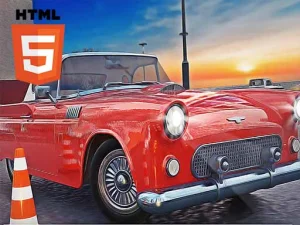
Inspect the destination before the final turn
Locate the target space early enough to choose an entry line. Consider the car's front, the route its rear will follow and the room available to slow down. A small correction made before a narrow section is easier to judge than several abrupt steering changes beside an obstacle.
Test the car's controls in an area where you can observe their response. Learn the brake, reverse and any camera option separately. A familiar-looking car does not guarantee that its keys or stopping behaviour match another title. Read the loaded instructions before planning a tight manoeuvre around an assumed control.
Stop cleanly in Park Perfect
Park Perfect: Car Simulator uses cone-lined lanes, bends, speed bumps and yellow parking slots. Contact with a cone, barrier or parked car ends the attempt. The final requirement includes stopping inside the slot and remaining still, so reaching the yellow area while continuing to move is not the whole task.
W or Up drives forward, S or Down reverses, A/D or horizontal arrows steer and Space brakes. C switches between behind-car and top-down cameras. R restarts and Escape pauses. Use a view that makes the current clearance readable, and leave room to brake before the final position.
The supplier lists touch-button instructions but also marks the build as not mobile-ready. Treat that as a reason to inspect the actual loaded interface, rather than a guarantee of phone compatibility. The keyboard setup is clearly documented and should be learned independently from another parking game's controls.
Navigate a city before entering the space
Parking Fury 3D combines city navigation, parking locations and avoiding police. Use the minimap to understand where the route leads, then bring attention back to the car's immediate surroundings. Reaching the right street and positioning for the space are separate stages of the attempt.
The developer describes taking cars and changing vehicles as the game progresses. When that happens, inspect the handling and the room needed for the new car instead of assuming the previous line works unchanged. Follow the controls and objective shown inside the current version.
Diagnose a failed manoeuvre from its beginning
After contact or a missed final position, look for the earlier decision that created the problem. You may have started turning too late, approached without braking room or concentrated on the front while the rear swept toward an obstacle. Pick one change for the next attempt and keep the opening otherwise familiar.
A restart makes another test possible, but it does not explain the mistake by itself. Use it with a specific purpose, such as a slower entry or a clearer camera view. That gives the next result something meaningful to compare against.
Choose the parking format that fits your session: an obstacle course with a strict contact rule or a city route with additional pressures. Read the individual game's final-position requirement, recovery controls and device information. The shared theme is precision around a destination, while each title defines the conditions under which that precision must be achieved.
For a final correction, check the vehicle's position relative to both sides of the space. Steering toward one boundary changes clearance at another part of the car. Watching the whole manoeuvre can explain why a seemingly small adjustment caused contact, even when the front appeared to have room.