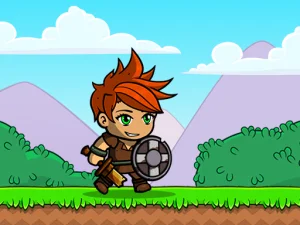
Separate placing the character from attacking
In Soul Essence Adventure, A and D or the left and right arrows move the character. W or Up jumps, S or Down rolls, and Space attacks. Practise distinguishing these actions before trying to solve a crowded encounter with several inputs together.
Movement determines where the character stands when an attack begins. Look at the enemy and the nearby surface before choosing that position. A hurried jump can turn a simple route problem into a fight you were not prepared to understand. Compare where a roll and a jump actually leave the character, then select the action that fits the visible space. Their separate controls give you distinct responses to learn.
Read a short section of the castle
Before advancing, identify a place where the character can stand and the direction from which a nearby enemy approaches. Decide whether the next useful action is moving, attacking or inspecting an interactive element. Giving the action a purpose makes its result easier to interpret.
Keep attention on the continuation as well as the next obstacle. Reaching a platform is helpful when it leaves a readable way onward. If the landing immediately creates another uncertainty, reconsider the approach rather than assuming that faster repeated inputs will solve it.
Use interaction and inventory deliberately
The documented controls include E for interaction and Tab for opening the inventory. Check the current situation before using an unfamiliar action. An item or prompt should give you a reason to interact, rather than treating every nearby object as if it must respond identically.
Inspect the information actually available in the inventory before planning around an object or resource. The existence of that menu does not establish a particular equipment system, item recipe or upgrade cost. Use what the current player shows to connect an available choice with the problem ahead.
Understand transformation as a distinct action
T is the documented transformation key. Knowing that the action exists does not tell you which forms or abilities are available immediately. Read the loaded game's instructions and feedback before assuming that a transformation provides a particular effect.
Test an unfamiliar action in a situation where its response can be understood. Then decide whether it helps with movement, an encounter or another visible task. Expecting a feature from a similarly themed adventure can make an unclear result harder to diagnose.
Review movement and combat separately
When a section proves difficult, identify which part first caused the problem. Did the character reach the intended position? Was an attack chosen from a useful distance? Did rolling or jumping do what you expected? These questions give a retry a more focused purpose.
Keep a successful movement as a reference while studying the encounter that follows, or practise a confusing input before changing the whole route. If every choice changes at once, you have less evidence about what improved. The objective remains escape through the current adventure, while your practice goal can concern one understandable action.
Other RPG entries may offer different viewpoints, objectives and progression. Read each game's own description before assuming shared statistics, quests, saving or equipment rules. Choose Soul Essence Adventure for its verified two-dimensional castle escape, and use its current interface for pause and progress information. Understanding the relation between position and action is a practical foundation for the next part of that journey.