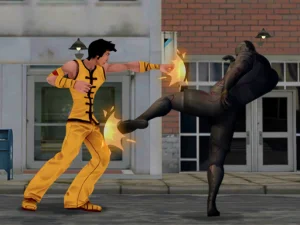
Identify the street fight in the player
Street Fighter opens the Street Fight game described here. The publisher lists ten enemy characters, five attack combinations and three locations: Sunset Avenue, Frozen Overpass and Mean Street. Those are useful reference points when reading the current menu and tutorial.
The established catalogue name should not be treated as a verified roster or special-move list from another fighting franchise. Follow the embedded version's instructions, particularly when learning how a pointer or touch controls the hero.
Begin by noticing which direction the character faces and where the nearest enemy is positioned. That gives your first movement a practical destination. You are trying to approach an encounter you can read, rather than produce as many attacks as possible before understanding the control response.
Learn movement and attacks as separate inputs
On desktop, moving the pointer guides the hero and clicking attacks. The touch instructions distinguish a short tap for an attack from holding and dragging to use the virtual movement control. Practise the action that fits your device before combining movement with a strike.
A brief test helps distinguish an intended approach from a misplaced attack. If the character did not move where expected, reconsider the movement input. If the position was correct but the exchange went badly, pay attention to the moment of the attack and the enemy's current distance.
Use the loaded tutorial for combinations. The published count of five does not give a reliable sequence of commands for every move. Learning what this game actually demonstrates is more useful than trying an unrelated arcade keyboard sequence.
Read the space around an exchange
Keep the target and the nearby route in view. Moving closer gives an attack a chance to reach, but it also changes the space available if you need another adjustment. Check the result of the exchange before assuming the hero should keep moving in the same direction.
When several enemies draw attention, choose the next action with a clear target. A purposeful click is easier to evaluate than repeated attacks while the pointer moves between unrelated positions. Let the current arrangement determine whether approaching, striking or creating more space has the clearest role.
After a difficult encounter, remember the first decision that made it hard to follow. You might have entered from an awkward position or confused the touch used for movement with a tap meant to attack. That gives a later attempt a specific action to improve.
Spend coins with the next encounter in mind
Victories provide coins. The shop describes improvements to damage, movement speed, maximum health and armour, alongside a temporary Power Pill effect. Read each current description and price before buying, using the available balance as the reference.
Those options concern different parts of the fight. Think about the problem you want to address, then compare the item's explanation with that problem. An improvement is a clearer choice when you understand why it could help the approach or exchange you are practising.
Explore another Street card when you want a different urban activity. Check its actual player title, controls and objective before carrying over these pointer or touch actions. In Street Fight, the useful opening is a controlled approach, an intended attack and a shop choice grounded in the encounters you have observed.
Keep a newly chosen shop improvement in mind during the next encounter so you can recognise which part of the exchange its explanation concerns.